
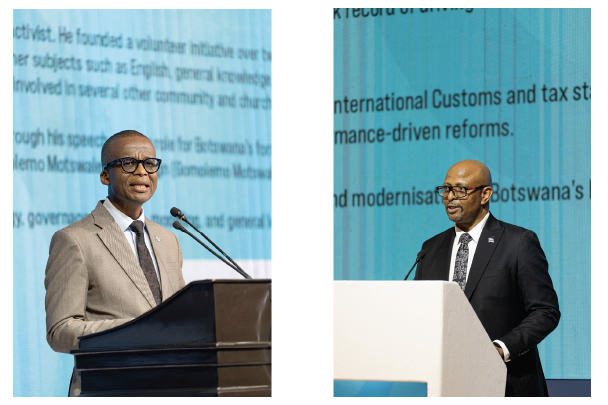

The 2026 BURS Tax Pitso showed that taxation is no longer simply about revenue collection it is about financing Botswana’s future.
There was a noticeable shift in tone as delegates settled into the 2026 BURS Tax Pitso. Conversations that might once have revolved around filing deadlines, tax audits and legislative amendments quickly gave way to something much broader. The room was no longer talking about tax in isolation. It was talking about Botswana’s future.
From policymakers and tax practitioners to finance executives, entrepreneurs and development partners, the message was remarkably consistent: Botswana’s fiscal future will depend as much on the efficiency of its tax system as it once depended on diamonds.
Held under the theme “Shaping Botswana’s Future Tax System: Dialogue for Fair and Sustainable Tax Reform,” this year’s Tax Pitso came at a defining moment. Government is pursuing economic diversification while navigating slower mineral revenues, growing public expenditure and increasing demands on public services. Against that backdrop, the annual gathering has evolved into more than a technical conference. It has become a forum where fiscal policy meets economic strategy.
Opening the proceedings, Acting President and Minister of Finance Ndaba Nkosinathi Gaolathe challenged delegates to view taxation as an instrument for national development rather than merely a mechanism for raising revenue. His remarks reflected a broader policy direction—one that seeks to build a tax system capable of supporting investment, encouraging voluntary compliance and financing Botswana’s long-term ambitions.
The message resonated throughout the day’s discussions.
“We have to move from collecting taxes to building a tax ecosystem that supports growth,” remarked one delegate during a panel discussion, capturing the mood that would define much of the event.
The pressure to do more with less
Botswana’s fiscal landscape is changing.
As revenues from the diamond sector become increasingly volatile, the pressure on domestic revenue collection continues to grow. During presentations at the Pitso, Botswana Unified Revenue Service (BURS) outlined its mandate to collect more than P66 billion during the 2026/27 financial year—a figure that reflects government’s increasing reliance on efficient tax administration to fund national priorities.
Those targets, widely reported by Mmegi following the national budget presentation, are not simply about balancing the books. They represent government’s broader effort to finance infrastructure, healthcare, education and economic transformation through a more resilient and diversified revenue base.
For many participants, the discussion was less about imposing new taxes than improving the performance of those already in place.
The revenue Botswana is leaving behind
One statistic surfaced repeatedly throughout the conference corridors and formal presentations alike.
Botswana’s VAT compliance gap.
According to figures shared by BURS and later reported by Mmegi, nearly 40 percent of potential VAT revenue is currently lost through under-declaration, non-compliance and weaknesses within the tax system.
The figure prompted lively discussion among delegates.
For tax practitioners, it highlighted opportunities to modernise compliance through technology. For business leaders, it reinforced the importance of stronger financial governance. And for policymakers, it underscored a reality that cannot be ignored: improving tax administration may deliver greater returns than introducing additional taxes.
Closing that gap, several speakers observed, could unlock billions of pula for national development without placing further pressure on compliant taxpayers.
A tax system for a digital economy
If one subject generated sustained debate throughout the Pitso, it was the taxation of digital services.
Streaming platforms, cloud computing, online advertising and subscription-based software have fundamentally altered the way commerce takes place. Yet tax systems around the world have often struggled to keep pace.
Botswana has now joined a growing list of jurisdictions seeking to address that imbalance.
BURS officials used the forum to explain the implementation of VAT on remote digital services supplied by foreign providers to Botswana consumers. The reform, introduced earlier this year, is expected to broaden the country’s tax base while creating a more level playing field for local businesses. Reporting by Mmegi indicates that the measure could contribute approximately P450 million annually once fully implemented.
Beyond the revenue projections, however, delegates recognised the reform as part of a much larger story.
As global commerce becomes increasingly digital, Botswana’s tax administration must evolve with it.
The conversation extended beyond compliance to questions of fairness, international competitiveness and the country’s readiness to participate in a rapidly changing global economy.
Building compliance through trust
One of the more striking observations during the Pitso was how little the conversation centred on enforcement.
Instead, speaker after speaker returned to the importance of collaboration.
Digital filing systems, taxpayer education, simplified compliance processes and ongoing engagement with business were repeatedly identified as critical to improving voluntary compliance.
The approach mirrors international best practice. Recent analysis by KPMG and PwC Botswana notes that Botswana’s proposed tax administration reforms place considerable emphasis on modernising tax processes, improving administrative efficiency and strengthening relationships between taxpayers and the revenue authority.
For corporate Botswana, the implications are significant.
Tax compliance is increasingly viewed not simply as a statutory obligation but as an indicator of sound governance. Investors, lenders and international partners are paying closer attention to how organisations manage tax risk, particularly as environmental, social and governance (ESG) considerations continue to influence investment decisions.
Beyond Tax Pitso
As delegates filtered out of the conference venue, many conversations continued in the corridors long after the final presentations had ended.
That, perhaps, is the clearest indication of how the Tax Pitso has evolved.
It is no longer simply an annual engagement between BURS and taxpayers. It has become one of the country’s most important platforms for discussing economic resilience, fiscal sustainability and the role of taxation in national development.
Botswana’s ambition to build a more diversified, knowledge-driven economy will require sustained investment in infrastructure, digital transformation, education and innovation. Financing that future will depend on a tax system that is efficient, trusted and capable of adapting to an increasingly complex global economy.
The discussions at the 2026 BURS Tax Pitso made one thing abundantly clear.
The conversation is no longer about paying tax.
It is about building the fiscal foundations of Botswana’s next economy.