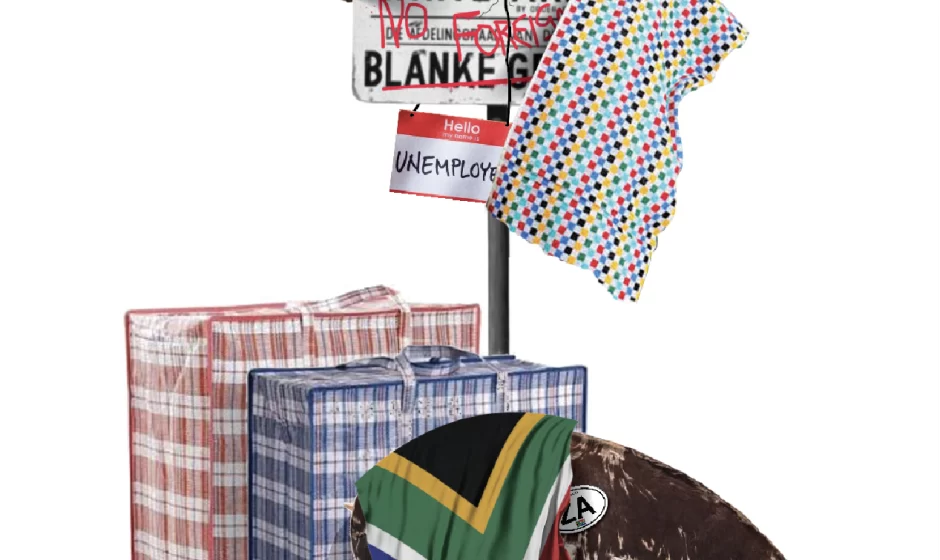

On an ordinary winter morning in Johannesburg, the streets fill with a familiar choreography of survival. Taxi operators negotiate impossible traffic with practiced precision, construction workers gather on pavements waiting for a day’s labour, informal traders arrange fruit and vegetables beneath faded umbrellas, and thousands of commuters stream towards a city that continues to promise opportunity while delivering disappointment to far too many. Somewhere in that restless movement, a protest begins. Placards appear. Songs rise into the cold air. Before long, the target of the public’s anger becomes unmistakable. Foreign-owned shops are identified. Zimbabwean migrants are accused of taking jobs. Somali businesses are labelled symbols of unfair competition. Once again, the frustrations of one of the world’s most unequal societies find their expression in the bodies and businesses of fellow Africans who, in many cases, arrived carrying little more than the hope of escaping crises of their own.
It is impossible to dismiss the emotions driving these demonstrations. South Africa’s unemployment crisis is not an abstraction discussed only in academic journals or economic forecasts; it is a lived experience that defines entire generations. Millions of young South Africans have reached adulthood without ever securing stable employment, while communities that celebrated the arrival of democracy more than three decades ago continue to wrestle with failing public services, deteriorating municipalities, persistent crime, rising living costs and an economy that has struggled to generate enough meaningful work. Under such conditions, frustration becomes not merely understandable but inevitable. Every society enduring prolonged economic hardship eventually begins searching for an explanation that transforms an overwhelming structural crisis into something tangible, something visible and, most importantly, something that appears capable of being confronted.
The tragedy unfolding in South Africa is not that people are asking difficult questions about immigration. Every sovereign nation has both the right and the responsibility to regulate its borders, administer lawful migration and distinguish between documented migrants, refugees, asylum seekers and those who reside within its territory without legal status. Those responsibilities are fundamental to the functioning of any modern state, and acknowledging them should not be mistaken for hostility towards migrants. The deeper problem emerges when immigration gradually evolves from being one policy challenge among many into the principal explanation for nearly every manifestation of social and economic distress. At that point, the debate ceases to be about border management and becomes instead a search for a convenient villain.
That transformation is politically seductive because immigrants are visible in ways that structural economic forces are not. A Zimbabwean carpenter renovating a suburban home is easy to identify. An Ethiopian shopkeeper operating from a township container is impossible to overlook. A Malawian gardener, a Congolese mechanic or a Mozambican construction worker all become tangible symbols onto which anxiety can be projected. By contrast, the forces that shape unemployment, inequality and economic exclusion operate quietly through institutions, financial systems, educational disparities, infrastructure failures, investment patterns, regulatory decisions and decades of accumulated policy choices. Structural inequality has no face to confront in the street. Capital concentration cannot be chased from a neighbourhood. The lingering effects of apartheid cannot be removed by closing a corner shop. Human psychology therefore gravitates toward explanations that are immediate and visible, even when those explanations account for only a fraction of the larger reality.
South Africa’s economic difficulties cannot be understood without recognising the extraordinary resilience of historical structures that survived the democratic transition. Political apartheid ended in 1994 through one of the most remarkable negotiated settlements in modern history, but political liberation did not instantly dissolve centuries of accumulated economic inequality. Democratic institutions transferred political authority to a representative government, yet the deeper architecture of wealth, productive assets, educational advantage, access to finance and inherited opportunity proved considerably more resistant to transformation. Considerable progress has undoubtedly been made through the emergence of a substantial Black middle class, expanded access to education, Black entrepreneurship and policies designed to broaden ownership and participation in the economy. Nevertheless, South Africa continues to rank among the world’s most unequal societies because historical patterns of exclusion continue to exert enormous influence over contemporary economic outcomes.
Compounding this unfinished transformation has been the corrosive impact of corruption and institutional decline. The years associated with state capture inflicted damage extending far beyond the theft of public funds. They weakened confidence in public institutions, undermined the operational capacity of state-owned enterprises, discouraged investment, delayed infrastructure development and contributed to a prolonged period of economic stagnation. The consequences of those failures continue to shape everyday life through unreliable electricity, deteriorating public services, constrained industrial expansion and diminished opportunities for employment. These are not problems that originated in migrant communities, nor are they problems that can be resolved through the removal of migrants.
Yet societies experiencing prolonged economic disappointment frequently search for explanations that are emotionally satisfying rather than analytically complete. Throughout history, periods of uncertainty have often produced movements that identify vulnerable outsiders as the principal source of domestic hardship. The pattern is neither uniquely South African nor uniquely African. Economic anxiety has repeatedly encouraged populations across continents to redirect legitimate frustrations toward groups possessing relatively little political or economic power. Such movements rarely emerge because the targeted communities genuinely control the structures responsible for national decline; rather, they emerge because those communities are sufficiently visible, politically vulnerable and socially accessible to serve as symbols of broader grievances.
The irony is particularly striking in the South African context because the country owes a profound historical debt to the solidarity of the African continent. During apartheid, neighbouring states opened their borders to South African exiles, hosted liberation movements, educated displaced students and accepted enormous diplomatic and economic costs in support of a struggle that transcended national boundaries. Botswana, Zambia, Tanzania, Mozambique, Zimbabwe and numerous other African countries understood that apartheid represented not merely a domestic injustice but a continental challenge to human dignity. Many of today’s migrants come from nations that once provided sanctuary to South Africans fleeing persecution. Their presence therefore reflects not simply patterns of economic migration but the complicated reciprocity of African history itself.
None of this should be interpreted as an argument against effective immigration enforcement. A functioning immigration system protects citizens, legitimate migrants and refugees alike by establishing clear legal pathways while reducing opportunities for criminal exploitation and human trafficking. Governments cannot abdicate responsibility for border management, and public concerns regarding undocumented migration deserve thoughtful policy responses rather than dismissal. The difficulty arises when immigration becomes the dominant lens through which every economic challenge is interpreted. Such an approach risks confusing symptoms with causes and temporary relief with lasting solutions.
Even in the hypothetical scenario where every undocumented migrant departed South Africa tomorrow, the country would still confront the formidable tasks of expanding productive industries, improving educational outcomes, restoring municipal governance, strengthening electricity generation, rebuilding investor confidence, encouraging entrepreneurship and addressing one of the deepest inequalities in the global economy. None of those challenges disappear when a foreign-owned shop closes its doors. None are resolved because a Zimbabwean labourer boards a bus home. They remain embedded within institutions, markets and historical patterns that require sustained political courage and long-term economic reform.
Perhaps this is the most unsettling aspect of the current moment. The contest unfolding in many South African communities increasingly pits those who possess the least power against others who possess only marginally more. Poor confronts poor. The unemployed compete against the precariously employed. Communities struggling to survive turn their attention toward neighbours who themselves escaped hardship elsewhere. Meanwhile, the larger questions concerning economic concentration, institutional renewal, educational transformation, industrial competitiveness and inclusive growth remain remarkably insulated from the intensity of public anger. It is not that these structural issues have disappeared from political debate; rather, they are significantly more difficult to mobilise around than the immediate visibility of migration.
The French Caribbean philosopher Frantz Fanon observed that societies emerging from systems of domination often carry psychological wounds that outlast the institutions responsible for creating them. When structural power appears distant, abstract or inaccessible, public anger frequently seeks expression through conflicts that occur among those sharing similar conditions of vulnerability. Fanon’s insight remains compelling not because it explains every instance of social conflict, but because it reminds us that injustice often survives by redirecting the frustrations of the excluded away from enduring structures and toward one another.
South Africa therefore finds itself confronting a defining choice. It can pursue a legitimate conversation about immigration while simultaneously undertaking the far more demanding work of economic transformation, institutional reconstruction and inclusive development. Or it can allow immigration to become a convenient narrative that obscures the more difficult questions surrounding inequality, opportunity, governance and the unfinished business of post-apartheid economic justice.
History rarely judges societies by the intensity of their anger. It judges them by whether they correctly identified the forces shaping their future. The greatest danger facing South Africa today is not simply that fellow Africans have become targets of public resentment. It is that a nation born from one of history’s greatest struggles against systemic injustice risks directing its moral energy toward those who neither designed that system nor possess the power to dismantle what remains of it.